 |
|
| English Setter - history of breed
Extract from The Swedish Setter Clubs standard of breed 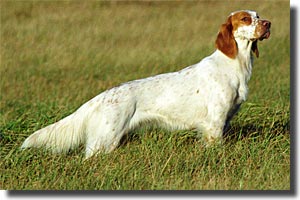 Translated by Torsti Mäkinen with the kind assistance from Ken McDougall, Adstock Pointers, UK. "Originally, dogs with setting and pointing instincts came from Spain. But it is The British who created The breed. They made it fast in the field, noble to regard and soft and friendly indoors. In the book The Gentleman's Recreation Nicholas Cox says: "The dog that you choose for "setting", must have a perfect nose and be by its nature dedicated to the pursuit of birds. " The year was 1697. So what did the author actually mean by "setting"? During the seventeenth century and later dogs that where called "setters" where used to point out where the partridges laid on the fields and by creeping drive the birds into the net. This demanded a dog that only had interest in partridges and that had the ability to co-operate whith its handler. It is quite certain that breeds similar to spaniels were used in the beginning. For a long period the setter was used in the practice of netting. Not until the beginning of the nineteenth century, when shooting became more widely spread, was the setter used in the way we today consider as the normal use of a pointing dog. Here the setter enters the Pointer's territory. To the shooting sportsman the pointer had been the natural choice since a long time back. Covering the ground with a high head, fast and stylish action, and excellently steady the setter suddenly was there exposing other benefits. Being of pure breed the setter showed a great measure of intelligence, acumen and from its ancestor - the spaniel - a faithfulness towards its master, a character catching most people. The effective and rugged setter with its durable paws was highly valued by the contemporary sportsmen. 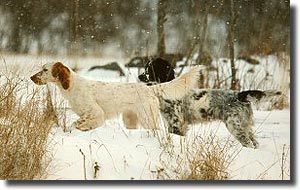 The setter resembled the springer spaniel (Translators note: compare the setter in the front to the springer backing it.) until the end of the eighteenth century when it was selectively bred, particularly in the Scottish highlands, to the appearance of the setter of today. Still it had the spaniels thick and curly coat as well as its heavy, round head. The setter resembled the springer spaniel (Translators note: compare the setter in the front to the springer backing it.) until the end of the eighteenth century when it was selectively bred, particularly in the Scottish highlands, to the appearance of the setter of today. Still it had the spaniels thick and curly coat as well as its heavy, round head.To these highlanders the working ability was always of first priority. There were no dogshows at this time. Individual owners developed types of setters that differed from kennel to kennel. However, some time later but still at an relatively early stage two types of setters were developed, the Field type and the Show type. The setter of today descends from the northern parts of England. It was from these famous kennels the dogs Ponto and Old Moll, that were bought by Edward Laverack, originated. These two setters had been bred by the priest A. Harrison in Carlisle who had had The same strain for 35 years. These dogs laid the foundation to E. Laveracks strain and with the sustained use of selective inbreeding, a principle the world had barely heard of before, much less could have mastered, Laverack created the english setter as we would recognise it today. Mr Laverack had an outstanding ability to pick the best puppies from the litters. He built a very homogenous strain and had great success in England at producing dogs for his shooting customers. Field trials were a development that began right at the end of his life. Although enthusiastic to them he was never a trialler. Trialling and showing started around 1860 - 1870. His strain has had very profound influence in the entire breed and is characterised by thoroughbred dogs that were well composed and calm, with a lovely, soft coat that always was coloured as blue or liver beltons. In addition his dogs had an outstanding stamina and prey drive and dominated the field trials of those days. 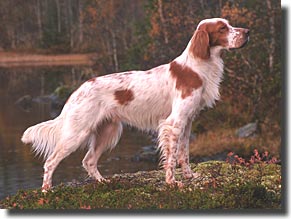 No setter strain in England could do without these new, healthy characters in Laveracks setters. But there was the reverse of the medal; With the strong selection for stamina in The Laverack setters, came a wildness in the field that was difficult to control. Their will to please and sense for contact with the handler decreased. They became more difficult to handle in The field. Still liberal breeders saved their best characteristics. We have to thank Mr R.L. Purcell-Llewellin for the breed that possesses the intractable prey drive of the Laverack setter as well as the Llewellin setter's intelligence.
From England the setter has spread all over the world. Both in the USA and on the Continent we can find superior setters and without exception the setter has been considered as a representative sporting dog. It has, with few exceptions, been allow to keep its appearance and the breeders have been wise enough to guard its intelligence. The English setter's history in our country is clearly very much younger. Not until the middle of the nineteenth century, when shooting over pointing dogs became popular, did the setter and the pointer first appear. Here the English setter has always been considered a sporting dog. The development towards this has lately become even more pronounced. The imports has been more or less successful. From the Storforsens Cry with blood from both Finland and Norway to The Heegaards H Jack of the 1990's, we have got a sporting dog that has all the characteristics we like to have and that was sought and found, very early by the English: a noble bird-dog with a lovely temperament. Equally suitable on the fields as well as in the mountains with its fascinating quartering for birds, the English Setter has a temper, a faithfulness and a wisdom that demands that we treasure it as the most noble of our sporting dogs".  Skedoms Foxy Borta Med Vindens Briz Home Skedoms Foxy Borta Med Vindens Briz Home |